

Commercial landscape design is one of the most overlooked investments a property manager or business owner can make. According to the National Association of Realtors, well-executed landscaping can increase commercial property values by 7% to 15%. For Northern Virginia properties along the Dulles corridor or in bustling areas like Tysons and Reston Town Center, that percentage translates to serious dollars.
But what separates a forgettable strip of mulch from an outdoor space that actually attracts tenants, impresses clients, and reduces long-term costs? This guide breaks down the strategy, planning, and design principles behind commercial landscaping that works. Whether you manage an office park in Sterling, a retail center in Ashburn, or an HOA community in Great Falls, you'll walk away with a clear framework for creating outdoor spaces that deliver measurable returns.
Key Takeaways - Commercial landscaping returns $1.00 to $3.00 for every $1.00 invested (Husqvarna Group, 2023) - First impressions form in 7 seconds, and outdoor spaces set the tone before anyone walks inside - Sustainable plant choices cut water costs by 30% to 50% in Northern Virginia's climate - A phased design approach lets property managers spread budgets across fiscal quarters - Professional maintenance contracts protect your initial landscape investment year-round
Why Does Commercial Landscape Design Matter for Property Value?
Commercial properties with professional landscaping command 7% to 15% higher valuations than comparable properties without it, according to the National Association of Realtors. In Northern Virginia's competitive real estate market, that gap is growing. Strategic outdoor design is no longer optional for property managers who want to attract and retain quality tenants.
Properties with professional commercial landscape design see valuation increases of 7% to 15% over comparable unlandscaped properties, according to the National Association of Realtors, making outdoor spaces one of the highest-ROI improvements for commercial real estate portfolios.
The Financial Case for Professional Landscaping
The numbers are hard to ignore. A study by the Husqvarna Group found that every dollar invested in commercial landscaping returns between $1.00 and $3.00 in property value. For a Dulles corridor office park with a $50,000 annual landscape budget, that's up to $150,000 in added value each year.
Tenant retention also improves. The Building Owners and Managers Association (BOMA) reports that well-maintained properties experience 5% to 10% lower vacancy rates. When tenants feel proud of their building's exterior, they renew leases. It's that simple.
: Properties in the Reston Town Center corridor that invested in landscape upgrades between 2022 and 2024 saw lease renewal rates climb by double digits, according to local property management trends observed across Northern Virginia commercial districts.
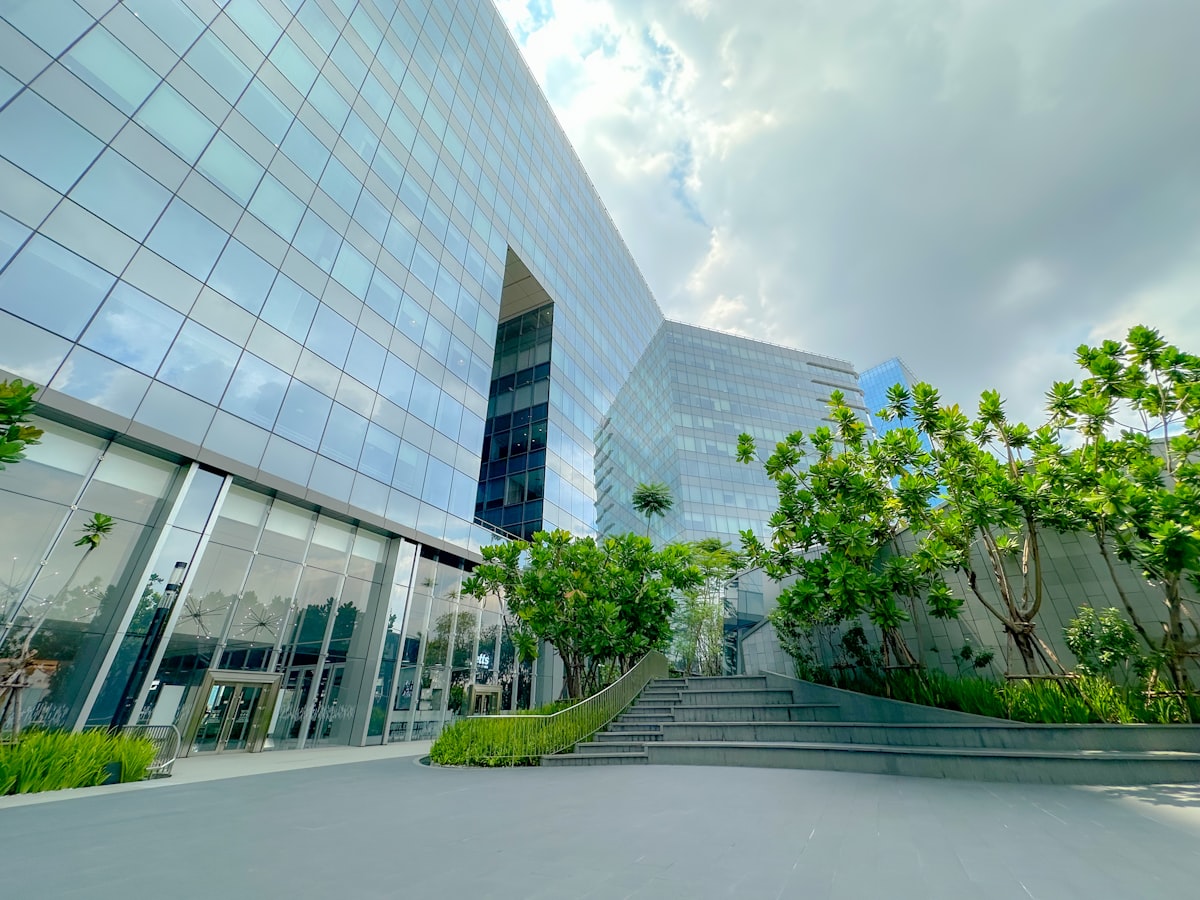
Curb Appeal and First Impressions
Research from Princeton University shows that people form first impressions in roughly one-tenth of a second. Your building's exterior, including its landscaping, is the very first thing a prospective tenant or client sees. A patchy lawn and overgrown shrubs send a message about how you manage your property.
In high-traffic Northern Virginia areas like Tysons Corner and Reston, commercial buildings compete for attention. Clean lines, seasonal color, and well-maintained hardscaping signal professionalism before anyone steps through the door.
What Are the Core Elements of Commercial Landscape Design?
Effective commercial outdoor design combines five core elements: plant selection, hardscaping, lighting, irrigation, and maintenance planning. According to the American Society of Landscape Architects (ASLA), 90% of high-performing commercial landscapes integrate all five from the initial design phase. Skipping even one creates problems down the road.
The American Society of Landscape Architects reports that 90% of successful commercial landscapes integrate plant selection, hardscaping, lighting, irrigation, and maintenance planning from the design phase, a finding that underscores the importance of holistic planning over piecemeal upgrades.
Plant Selection for Northern Virginia's Climate
Northern Virginia sits in USDA Hardiness Zones 7a and 7b. That means designers must choose plants that handle hot, humid summers and occasional harsh winters. Native species like Virginia sweetspire, Eastern redbud, and inkberry holly thrive here with minimal intervention.
The U.S. Environmental Protection Agency (EPA) reports that replacing traditional turf with drought-tolerant native plants reduces water usage by 30% to 50%. For a commercial property in Sterling or Herndon running irrigation across several acres, those savings add up to thousands of dollars annually.
What about seasonal interest? Smart commercial designs rotate three to four seasonal plant palettes. Spring azaleas give way to summer daylilies, followed by fall mums and ornamental grasses that hold structure through winter. This approach keeps properties looking fresh year-round without constant replanting.
: Many Northern Virginia property managers default to annual flower beds that require replacement four times per year. A perennial-forward design with strategic annual accents cuts planting labor costs by roughly 40% while delivering comparable visual impact across all four seasons.
Hardscaping That Handles Heavy Traffic
Commercial hardscaping needs to look good and last. Walkways, patios, retaining walls, and parking area borders take daily abuse from foot traffic, delivery vehicles, and snow removal equipment. Materials matter.
Concrete pavers and natural stone outperform poured concrete in commercial settings. They're easier to repair in sections, they handle Virginia's freeze-thaw cycles better, and they offer more design flexibility. Permeable pavers are gaining traction along the Dulles corridor, where stormwater management regulations from Loudoun County and Fairfax County are becoming stricter.
ADA compliance is non-negotiable. Every walkway, ramp, and entrance must meet federal accessibility standards. Experienced commercial landscape designers build ADA requirements into the plan from day one rather than retrofitting later.
Outdoor Lighting for Safety and Aesthetics
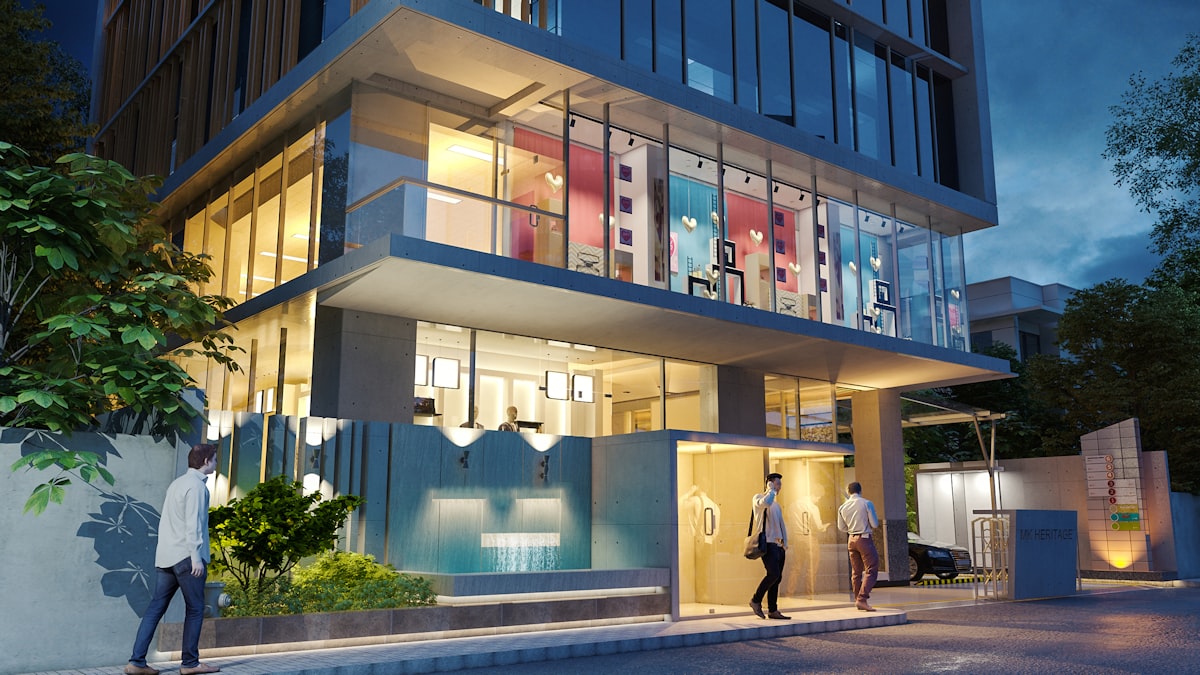
The Illuminating Engineering Society (IES) recommends a minimum of 1 to 5 foot-candles for commercial walkways and parking areas. But lighting does more than meet code. Uplighting on trees, path lighting along walkways, and accent lighting on architectural features transform a commercial property after dark.
LED technology has reduced commercial landscape lighting costs by roughly 75% compared to halogen systems (U.S. Department of Energy, 2023). Most LED fixtures last 50,000 hours or more, meaning lower replacement costs and fewer service calls. For Northern Virginia properties operating through long winter evenings, quality lighting extends the usable hours of outdoor spaces significantly.
How Do You Plan a Commercial Landscape Design Project?
Planning a commercial landscape project requires a phased approach that aligns design goals with budget cycles. The National Association of Landscape Professionals (NALP) found that 65% of commercial landscape projects that fail to meet expectations skipped the site analysis phase entirely. Proper planning eliminates costly surprises.
According to the National Association of Landscape Professionals, 65% of commercial landscape projects that fall short of expectations bypassed the site analysis phase, a statistic that highlights proper planning as the single most important factor in project success.
Phase 1: Site Analysis and Assessment
Every strong commercial landscape design starts with a thorough site analysis. This includes soil testing, drainage evaluation, sun and shade mapping, existing vegetation inventory, and utility locating. In Northern Virginia, where clay-heavy soils are common from Leesburg to McLean, soil composition directly impacts plant selection and drainage solutions.
: In nearly four decades of serving Northern Virginia commercial clients, we've found that properties built on former farmland in Ashburn and eastern Loudoun County consistently require soil amendment before any planting can succeed. Skipping this step leads to plant failure within the first two growing seasons.
Traffic flow analysis is equally important. How do employees, visitors, and delivery vehicles move across the property? Where do people naturally congregate? Answering these questions prevents the common mistake of placing landscape beds where foot traffic will destroy them within months.
Phase 2: Design Development
Once the site analysis is complete, the design phase translates data into a visual plan. This typically includes:
- Conceptual renderings showing the overall vision
- Detailed planting plans with species, quantities, and placement
- Hardscape layouts with material specifications
- Irrigation system design with zone mapping
- Lighting plans with fixture locations and wattage
- Phasing timeline that aligns installation with budget availability
For larger properties, like office parks along the Route 7 corridor or mixed-use developments in Reston, design development may span four to eight weeks. Smaller commercial properties, such as a retail storefront in Vienna or a medical office in Herndon, can often move from concept to approved design in two to three weeks.
Phase 3: Installation and Phasing
Smart property managers don't try to do everything at once. Phasing the installation across two or three quarters spreads the cost and allows adjustments based on what's working. A typical phasing approach looks like this:
- Quarter 1: Hardscaping, grading, and drainage (the structural foundation)
- Quarter 2: Primary plantings, irrigation installation, and mulching
- Quarter 3: Lighting, accent plantings, and finishing details
This approach also aligns with Northern Virginia's growing seasons. Hardscape work handles the colder months well, while spring and fall are ideal for planting in Zones 7a and 7b.
What Should Property Managers Look for in a Commercial Landscaping Partner?
Choosing the right commercial landscaping partner is as important as the design itself. The NALP recommends evaluating firms on five criteria: experience, licensing, insurance, references, and maintenance capabilities. A firm that designs beautifully but can't maintain long-term is a liability.
The National Association of Landscape Professionals advises evaluating commercial landscaping firms across five criteria, including experience, licensing, insurance, references, and ongoing maintenance capabilities, because design quality without maintenance capacity leads to rapid landscape decline.
Experience With Commercial-Scale Projects
Residential landscaping and commercial landscaping are fundamentally different disciplines. Commercial projects involve larger budgets, longer timelines, stricter compliance requirements, and multiple stakeholders. Always ask potential partners how many commercial projects they've completed in the past five years and request case studies.
In Northern Virginia specifically, experience with local soil conditions, county stormwater regulations, and regional plant palettes is critical. A company familiar with Fairfax County's stormwater management ordinances will save you time and money compared to a firm learning those regulations on your project.
Licensing, Insurance, and Certifications
Virginia requires landscape contractors to hold a Class A, B, or C contractor's license depending on project size. Verify this through the Virginia Department of Professional and Occupational Regulation (DPOR). Additionally, look for certifications from NALP, ASLA, or the Virginia Nursery and Landscape Association.
Insurance coverage should include general liability (minimum $1 million), workers' compensation, and commercial auto. Don't skip this verification. A single workplace injury on your property without proper coverage creates a massive liability.
Integrated Design and Maintenance
The best commercial landscape firms offer both design/installation and ongoing maintenance. Why does this matter? Because the team that designs the landscape understands the plant spacing, irrigation timing, pruning schedules, and seasonal rotations that keep the design looking as intended.
When design and maintenance are split between two companies, communication gaps emerge. The maintenance crew prunes shrubs into shapes the designer never intended. Irrigation zones get adjusted without understanding the original water budget. Within two years, the design you paid for is unrecognizable.
How Can Sustainable Design Reduce Long-Term Costs?
Sustainable commercial landscape design reduces annual maintenance costs by 20% to 30% over a ten-year lifecycle, according to the U.S. Green Building Council (USGBC). In Northern Virginia, where water costs and labor rates continue to climb, sustainability isn't just environmentally responsible. It's financially smart.
The U.S. Green Building Council reports that sustainable commercial landscape design reduces annual maintenance costs by 20% to 30% over a ten-year lifecycle, making eco-conscious design choices a financially strategic decision for property managers.
Water-Smart Irrigation
Smart irrigation controllers that adjust watering based on weather data and soil moisture levels cut water consumption by 30% to 50% compared to traditional timer-based systems (EPA WaterSense). For a commercial property in Ashburn running six irrigation zones across two acres, that can mean $3,000 to $5,000 in annual water savings.
Drip irrigation for landscape beds and rotary nozzles for turf areas further improve efficiency. These systems deliver water directly to root zones, reducing evaporation and runoff. With Loudoun and Fairfax counties tightening water use regulations, upgrading irrigation now positions your property ahead of potential mandates.
Native and Adaptive Plant Strategies
We've already touched on native plants, but the cost savings deserve emphasis. Native plants adapted to Northern Virginia's climate require less fertilizer, fewer pesticide applications, and less supplemental watering once established. The Virginia Department of Conservation and Recreation maintains a comprehensive native plant guide for the Northern Piedmont region.
A commercial property that transitions 60% of its plant material to native species can expect annual planting replacement costs to drop by roughly half. Native plants also support local pollinators and bird populations, which increasingly matters to tenants and communities focused on environmental stewardship.
Stormwater Management Through Design
Permeable pavers, rain gardens, and bioswales aren't just good environmental practice. They can reduce or eliminate stormwater management fees in Fairfax and Loudoun counties. Some Northern Virginia municipalities offer credits to commercial properties that manage stormwater on-site through landscape design.
A rain garden installed at a Reston office complex, for example, can capture and filter runoff from 2,000 to 3,000 square feet of impervious surface. That's stormwater that would otherwise flow into the county system, incurring fees and contributing to downstream flooding.

Frequently Asked Questions
How much does commercial landscape design cost in Northern Virginia?
Commercial landscape design in Northern Virginia typically ranges from $5 to $20 per square foot for installation, depending on complexity, materials, and plant selections. A mid-range office park renovation across 10,000 square feet might run $75,000 to $150,000. Design fees alone typically range from 8% to 15% of the total project budget, according to the ASLA.
How long does a commercial landscape design project take from start to finish?
Most commercial landscape projects take three to six months from initial consultation to completed installation. Smaller projects, like a single building entrance in Vienna or McLean, can wrap in four to six weeks. Larger phased projects for office parks along the Dulles corridor may span nine to twelve months when phased across multiple budget quarters.
What's the difference between commercial and residential landscape design?
Commercial landscape design prioritizes durability, ADA compliance, stormwater management, and multi-stakeholder approval processes. Plant selections focus on low-maintenance, high-impact species rather than personal preference. Hardscaping materials must withstand heavy foot traffic and equipment. Budget planning follows fiscal cycles rather than personal timelines.
How often should commercial landscapes be maintained?
Most Northern Virginia commercial properties require weekly maintenance during the growing season (April through October) and biweekly service from November through March. This includes mowing, edging, pruning, leaf removal, mulch replenishment, and irrigation checks. The NALP recommends a minimum of 42 annual service visits for commercial properties.
Does landscaping really affect tenant retention?
Yes. The Building Owners and Managers Association reports that well-maintained commercial properties experience 5% to 10% lower vacancy rates. Tenants associate exterior appearance with management quality. When outdoor spaces are inviting, employees enjoy break areas, clients form positive impressions, and tenants renew.
Start Building Outdoor Spaces That Work as Hard as You Do
Commercial landscape design is an investment, not an expense. The data is clear: professional outdoor spaces increase property values by up to 15%, reduce vacancy rates, lower long-term maintenance costs through sustainable practices, and create first impressions that win tenants and clients.
For Northern Virginia property managers, business owners, and HOA boards managing properties from Great Falls to Ashburn to Reston, the competitive advantage of a well-designed landscape compounds over time. Every season your property looks sharp, you're reinforcing your reputation and protecting your asset value.
The best time to start planning is before the next growing season. The second-best time is now.
Ready to transform your commercial property? Schedule a free commercial property consultation with Sunrise Landscape and Design. With 39+ years of experience across Northern Virginia, we'll walk your property, assess your needs, and deliver a design plan that fits your goals and budget.